ConvergențeConvergences
Muzică. Poezie. Lumină. Music. Poetry. Light.
sunet. cuvânt. pixel. sound. word. pixel.
ConvergențeConvergences
sunet. cuvânt. pixel. sound. word. pixel.
Lavinia Bujor-Deaconu nu a ales între muzică, poezie și artă vizuală. Le practică pe toate și a descoperit că sunt același act privit din unghiuri diferite.
Mezzosoprana care a cântat Bach și de Falla știe că muzica nu este sunet — este tensiune înainte de sunet, spațiul dintre note, respirația care precede vocea. Din această știință corporală, profundă și neverificabilă prin cuvinte, s-a născut principiul central al Trans-Luminismului Digital: tensiunea precede forma.
Poezia ei nu comentează lucrările vizuale — le precede sau le urmează, ca o altă respirație a aceluiași corp.
Lavinia Bujor-Deaconu did not choose between music, poetry and visual art. She practises all of them and has discovered that they are the same act seen from different angles.
The mezzosoprano who sang Bach and de Falla knows that music is not sound — it is tension before sound, the space between notes, the breath that precedes the voice. From this corporeal, deep knowledge — unverifiable by words — was born the central principle of Digital Trans-Luminism: tension precedes form.
Her poetry does not comment on the visual works — it precedes or follows them, like another breath of the same body.
„Precum fotonul în dualismul său undă — corpuscul, când interacționez cu materia, mă comport precum o particulă iar când sunt liberă devin o undă." "Like the photon in its wave-particle duality, when I interact with matter I behave like a particle, and when I am free I become a wave."
Lavinia Bujor-Deaconu, mezzosoprană Lavinia Bujor-Deaconu, mezzosoprano
Poezie · Lucrare · Reflecție Poem · Artwork · Reflection
PoeziePoem
Cuceresc timpul
Cu fiecare amintire
Ce nu mi-a fost ștearsă
Pun deoparte câteva secunde
Din fiecare zi pe care o trăiesc
Și nu le pierd niciodată.
Mă pun deoparte de viața
Pe care o trăiesc
Și nu o pierd niciodată.
Îmi pun deoparte câteva respirații
Pentru ca atunci când voi pierde în fața timpului
Să mai adun câteva amintiri
Cu care am să zbor liniștită.
I conquer time
With every memory
That was not erased from me
I set aside a few seconds
From each day that I live
And never lose them.
I set myself apart from the life
That I live
And never lose it.
I set aside a few breaths
So that when I lose to time
I may gather a few more memories
With which I shall fly, at peace.
din volumulfrom the volume
Mă bucur de viață
sau Jurnal fără timp
Pământ necunoscutUnknown Land
Ciclul „Anatomia Invizibilului" · Seria Timp Cycle "Anatomy of the Invisible" · Time Series
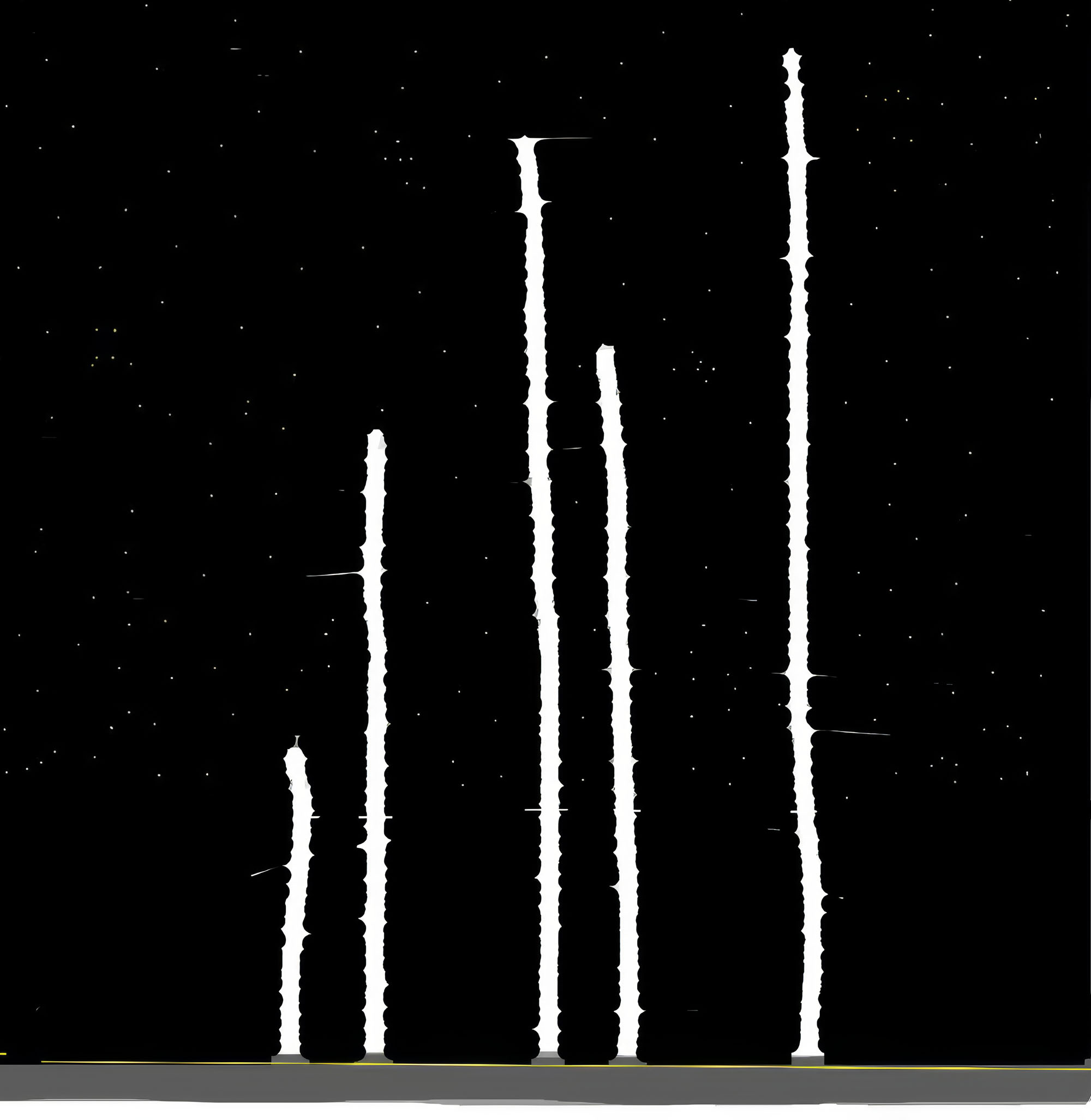
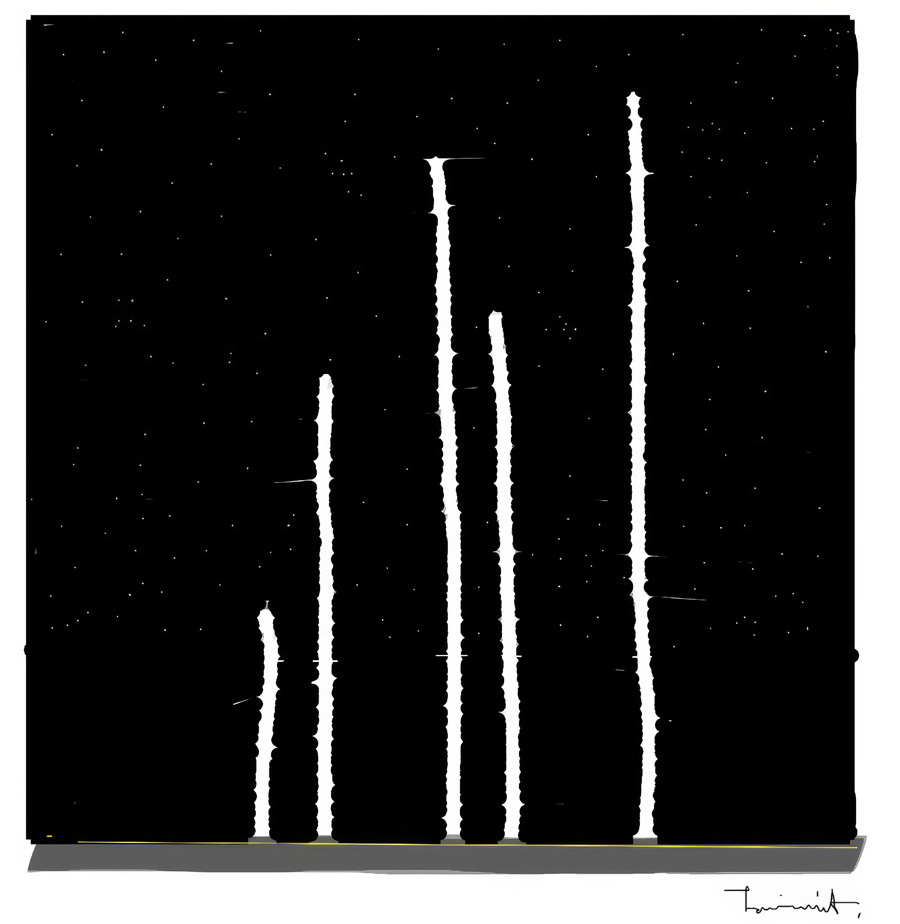
Marginile coloanelor nu sunt drepte — sunt granulate, neregulate. Aceasta este textura timpului, acumularea organică, imperfectă, vie a momentelor.
La baza întregii compoziții, abia vizibilă — o linie galbenă subțire, linia vieții, prezentul, solul din care coloanele cresc.
Fiecare granulă din textura coloanelor este o secundă pusă deoparte. Acumularea este posibilă — pus deoparte, timpul devine coloană albă în negrul cosmic.
The edges of the columns are not straight — they are granulated, irregular. This is the texture of time, the organic, imperfect, living accumulation of moments.
At the base of the entire composition, barely visible — a thin yellow line, the line of life, the present, the soil from which the columns grow.
Every granule in the texture of the columns is a second set aside. Accumulation is possible — set aside, time becomes a white column in the cosmic black.
ContextContext
"Respirații" notează gestul discret de a pune deoparte câteva secunde din fiecare zi, câteva respirații, pentru a zbura liniștită.
Timpul nu se pierde complet dacă îl pui deoparte cu intenție. Gestul de retragere — din viață, din timp, din gălăgie — nu este abandon. Este construcție.
Coloanele albe din lucrare sunt tocmai aceste respirații acumulate: invizibile când se produc, monumentale când sunt privite din afară.
Poezia și lucrarea vorbesc despre același act: economisirea prezenței pentru a supraviețui timpului.
"Breaths" notes the discreet gesture of setting aside a few seconds from each day — a few breaths — in order to fly at peace.
Time is not entirely lost if you set it aside with intention. The act of withdrawal — from life, from time, from noise — is not abandonment. It is construction.
The white columns in the artwork are precisely these accumulated breaths: invisible when they occur, monumental when viewed from outside.
The poem and the work speak of the same act: saving presence in order to survive time.
„Această carte de poezie este o călătorie în jurul lumii sau în inima aventurii personale."
Prof. Univ. Dr. Luiza Spiru
"This book of poetry is a journey around the world or into the heart of personal adventure."
Prof. Univ. Dr. Luiza Spiru
Poezie · Lucrare · Reflecție Poem · Artwork · Reflection
PoeziePoem
Iubirea este Dumnezeu
Și Dumnezeu este iubire
În teoremă e un alizeu
Ce-mpiedică-a ciclonului venire.
În teoreme dacă demonstrezi
Premise și concluzii
Cu reciproce ilustrezi
Iubirea în iluzii.
Exemplul cel mai elocvent
Este cuvântul dacă
Frecvent moment, frecvent solvent
Dizolvă dragostea, în joacă.
Dar mai presus de logica lui dacă,
Iubirea necondiționată
În infinit plus doi îmbracă
Un dacă-n semiumbră calculată.
Cu neputința definirii se hrănește!
Iubirea adevărată e un dar.
În demonstrații, reciprocități stârnește
Tot ce-i suficient și necesar.
Iubirea este Dumnezeu
Un Dumnezeu fecundul
În embrionul planetar
Apoi născând străfundul.
Love is God
And God is love
In the theorem there is a trade wind
That prevents the cyclone's coming.
In theorems if you prove
Premises and conclusions
With converses you illustrate
Love in illusions.
The most eloquent example
Is the word if
Frequent moment, frequent solvent
It dissolves love, in play.
But above the logic of if,
Unconditional love
In infinity plus two wraps
An if in calculated penumbra.
It feeds on the impossibility of definition!
True love is a gift.
In demonstrations, it stirs reciprocities
Of all that is sufficient and necessary.
Love is God
A fecund God
In the planetary embryo
Then giving birth to the abyss.
din volumulfrom the volume
Geometria iubirii The Geometry of Love
AlternativăAlternative
Ciclul „Anatomia Invizibilului" · Seria Rodicăi Bujor — Muzicală Cycle "Anatomy of the Invisible" · Rodicăi Bujor — Muzicală Series
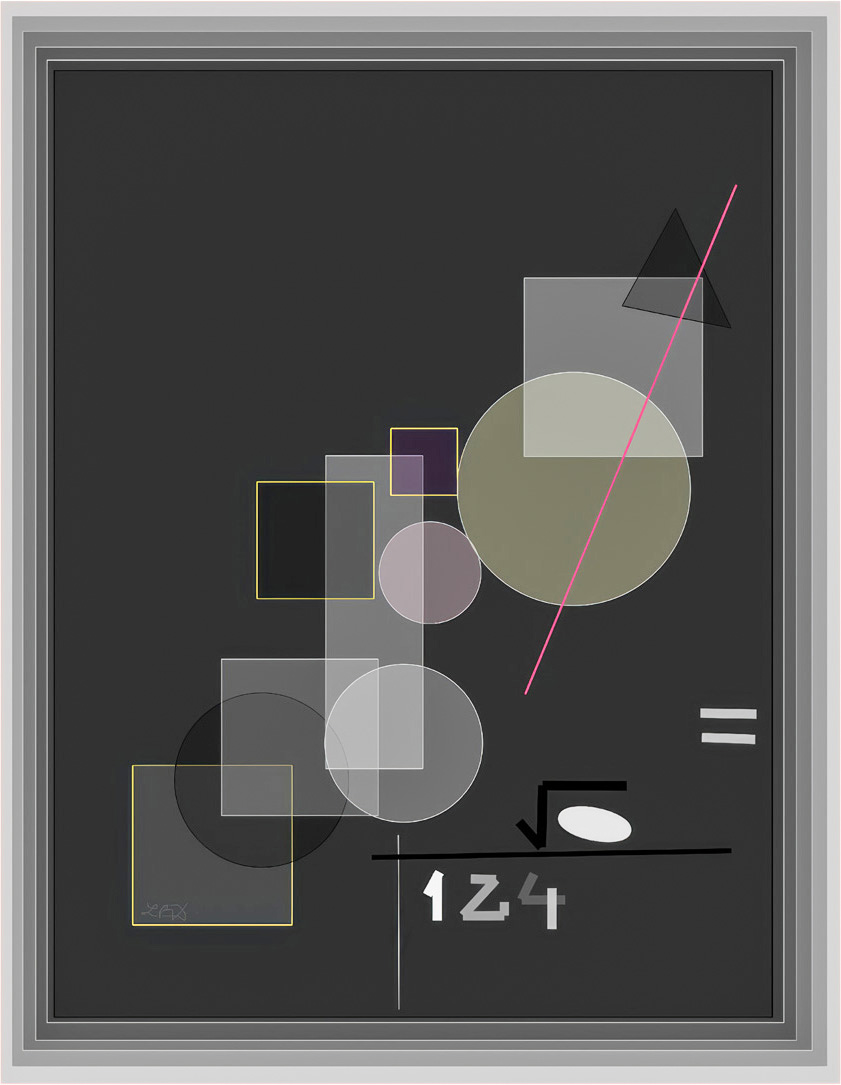
√, rădăcina sunetului = 124, formula muzicii, ovalul alb — necunoscuta în ecuație. Nu este o ecuație rezolvabilă — este o metaforă matematică.
Octava în muzică este exact dublarea frecvenței: 1, 2, 4…
Artista nu explică — afirmă. Există o rădăcină a muzicii. Există un egal. Există numerele. Descifrarea este a privitorului.
√, the root of sound = 124, the formula of music, the white oval — the unknown in the equation. It is not a solvable equation — it is a mathematical metaphor.
The octave in music is precisely the doubling of frequency: 1, 2, 4…
The artist does not explain — she affirms. There is a root of music. There is an equal sign. There are numbers. The deciphering belongs to the viewer.
ReflecțieReflection
Iubirea este Dumnezeu — teorema.
Dumnezeu este iubire — reciproca.
Ecuația există, egalul există, numerele există. Dar iubirea ca variabilă care nu se poate calcula.
„Cu neputința definirii se hrănește! Iubirea adevărată e un dar." Iubirea se hrănește din imposibilitatea de a fi definită.
Este o antiteză perfectă față de tot aparatul logic construit — și tocmai de aceea este adevărată. Demonstrația eșuează deliberat și în acest eșec deliberat stă tot adevărul.
Love is God — the theorem.
God is love — the converse.
The equation exists, the equals sign exists, the numbers exist. But love as a variable that cannot be calculated.
"It feeds on the impossibility of definition! True love is a gift." Love feeds on the impossibility of being defined.
It is a perfect antithesis to the entire logical apparatus constructed — and that is precisely why it is true. The proof fails deliberately, and in this deliberate failure lies all truth.
Sorin Nicolae Deaconu, matematician
Sorin Nicolae Deaconu, mathematician
Poezie · Lucrare · Reflecție Poem · Artwork · Reflection
PoeziePoem
Am plecat să caut lumea
Și lumină înțeleaptă,
Înspre-acolo-mi trage foamea
Inimii, — ea mă îndreaptă.
Întărește-mi Doamne ochii
Pentru-a o putea vedea
Numai Tu poți să mă-apropii
Numai Tu și mâna Ta.
Doamne!... am ajuns pe creastă!...
Lasă-mi din belșug lumină
O lumină pură, castă
Peste firea mea puțină.
Peste culmea sferică,
Nu s-a arătat lumină,
Lumina Taborică
Necreată de vreo mână.
Poate într-o zi primi-va
De la Tatăl nostru Mare
O lumină ce sosi-va
Necreată-n luminare.
Dintr-o conștiință pură
Îi ajută dacă vin
Pe acei cu viața dură
Vărsând raze din preaplin.
Tace către Dătătorul
De lumină și de lege,
Tace-n rugă bătrâiorul
Fruntea-adâncă și-o mai șterge.
I set out to seek the world
And a wise light,
My heart's hunger pulls me there, —
It guides me on my way.
Lord, strengthen my eyes
That I might see it
Only You can bring me near
Only You and Your hand.
Lord!... I have reached the crest!...
Grant me light in abundance
A pure, chaste light
Upon my little nature.
Over the spherical summit,
No light revealed itself,
The Taboric Light
Uncreated by any hand.
Perhaps one day he will receive
From our great Father
A light that will arrive
Uncreated in illumination.
From a pure conscience
He helps those who come
To those with a hard life
Pouring out rays from abundance.
He is silent toward the Giver
Of light and of law,
The old man is silent in prayer
Still wiping his furrowed brow.
din volumulfrom the volume
Fericiri — Cartea I Beatitudes — Book I

înviereaThe Resurrection
Ciclul „Anatomia Invizibilului" · Seria Simțiri Cycle "Anatomy of the Invisible" · Feelings Series
Cristian Isihastul pleacă să caute lumina taborică — lumina necreată, lumina care a strălucit pe Hristos în momentul transfigurării.
Ovalul alb în negrul aproape absolut este exact această lumină — nu reprezentarea ei, ci prezența ei pură. Ovalul nu strălucește spectaculos. Există simplu, pur, fără să ceară nimic.
Cristian nu a văzut-o pe Tabor. Dar ea era acolo tot timpul — simplă, albă, în negrul absolut al căutării.
Christian the Hesychast sets out to seek the Taboric light — the uncreated light, the light that shone on Christ at the moment of Transfiguration.
The white oval in the near-absolute black is precisely this light — not its representation, but its pure presence. The oval does not shine spectacularly. It simply exists, pure, asking for nothing.
Christian did not see it on Tabor. But it was there all along — simple, white, in the absolute black of searching.
ReflecțieReflection
"Căutătorul de Lumină" — ciclul poetic al Cristian Isihastului care pleacă spre Tabor și nu vede lumina taborică — este autobiografia invizibilă a întregii opere.
Nu revelația spectaculoasă, ci darul mai mic și mai prețios de a vărsa raze din preaplin pentru cei care vin.
„Peste culmea sferică,
Nu s-a arătat lumină."
A spune că ai urcat și nu ai văzut, și ai continuat totuși — aceasta este, în orice limbaj și în orice artă, singurul act de credință real.
Această carte începe cu o dimineață și se termină cu o tăcere. Între ele — un drum, o lume văzută cu ochii deschiși, un munte urcat și o lumină care nu apare în forma așteptată.
"The Seeker of Light" — the poetic cycle of Christian the Hesychast who sets out for Tabor and does not see the Taboric light — is the invisible autobiography of the entire work.
Not the spectacular revelation, but the smaller and more precious gift of pouring out rays from abundance for those who come.
"Over the spherical summit,
No light revealed itself."
To say that you climbed and did not see, and continued nonetheless — this is, in any language and in any art, the only real act of faith.
This book begins with a morning and ends with a silence. Between them — a journey, a world seen with open eyes, a mountain climbed and a light that does not appear in the expected form.
„Astfel nu putem vedea sau cunoaște ființa Dumnezeu, o ființă inaccesibilă, rămânând o veșnică taină."
Lavinia Bujor-Deaconu
"Thus we cannot see or know the being of God, an inaccessible being, remaining an eternal mystery."
Lavinia Bujor-Deaconu
Muzica, poezia și lumina digitală nu sunt trei domenii ale aceleiași artiste. Sunt trei instrumente cu care aceeași întrebare este pusă de fiecare dată altfel:
Ce formă are invizibilul?
Răspunsurile diferă. Întrebarea rămâne.
Music, poetry and digital light are not three domains of the same artist. They are three instruments with which the same question is asked each time differently:
What form does the invisible take?
The answers differ. The question remains.